AML/CTF Compliance
Officer Certification.
New AML/CTF regime. New expectations.
It’s a regulatory requirement for AML/CTF Compliance Officers to be competent and skilled. Our certification builds that capability and gives directors peace of mind.
Be recognised. Build confidence. Meet your obligations.
Over 12 weeks you will develop the knowledge and skills needed to oversee an effective AML/CTF Program.

Live webinars
Learn directly from leading AML/CTF experts in live weekly group trainings.
Topics
2 h/weekEach week covers a key AML/CTF obligation and how to satisfy it.
Q&A
1 h/weekJoin an optional weekly group Q&A to get answers to your questions.
Assess understanding
Test you knowledge of key concepts and their practical application.

Certification
Earn a recognised certification that demonstrates expertise and skills.
Templates
Access ready-to-use AML/CTF template checklists, logs and forms.
Certification Structure
Week 1Foundations of AML/CTF
Gain a clear understanding of the AML/CTF regime in Australia, its core principles and the key obligations required to be satisfied. Learn how to interpret the Act, Regulations, Rules, and guidance, and how to use them to understand your obligations and how to satisfy them.
Week 2ML/TF Risk Assessment
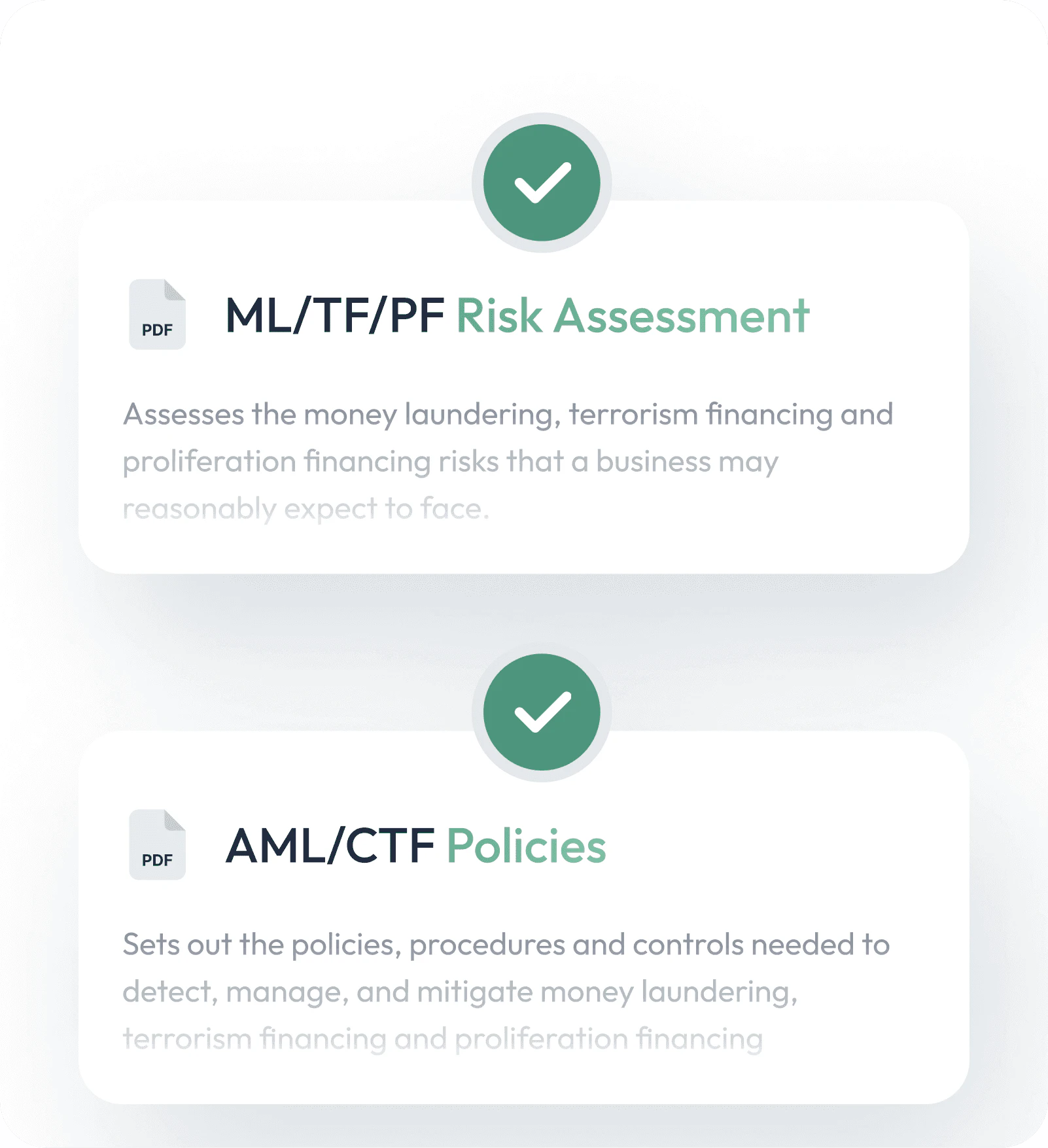
Learn what money laundering, terrorism financing, and proliferation financing are, the key threats facing Australia and various industries, and how these threats exploit business vulnerabilities. Learn how to conduct ML/TF Risk Assessments, as well as the common mistakes that businesses make when conducting a ML/TF Risk Assessment and how to avoid them.
Week 3AML/CTF Policies
Learn what policies, procedures, and controls are, and the obligations that must be addressed within AML/CTF Policies. Learn how to design procedures and controls that satisfy regulatory obligations, as well as the common mistakes that businesses make when developing AML/CTF Policies and how to avoid them.
Week 4Employee due diligence & AML/CTF training
Learn who employee due diligence must be conducted on, when it should be completed, and how to carry it out effectively. Learn who must receive AML/CTF training, what training should be delivered for different roles, and when it should be provided. Learn the common mistakes businesses make when conducting employee due diligence and delivering AML/CTF training, and how to avoid them.
Week 5 to 7Customer due diligence
Learn the purpose and process of conducting customer due diligence ("CDD"), including when and how to conduct initial, ongoing, simplified, and enhanced CDD. Learn how to conduct politically exposed person checks, and how to handle findings. Learn how to develop and apply customer risk assessments, when exceptions may be granted, and how to work effectively with agents or third parties. Learn the common issues businesses face when conducting CDD and how to avoid them.
Week 8Account and transaction monitoring
Learn how to conduct account and transaction monitoring effectively. Learn how to develop red flags and transaction monitoring rules for your business, and the types of red flags your business and industry is exposed to. Learn how to assess whether a Suspicious Matter Report ("SMR") should be submitted to AUSTRAC and how to submit a SMR. Gain clarity on tipping off and legal privilege, and how they apply in practice.
Week 9Reporting to AUSTRAC
Learn how to identify and submit reports to AUSTRAC, including Compliance Reports, International Funds Transfer Instruction Reports, and Threshold Transaction Reports. Understand when each report must be submitted, what information is required, and how to ensure reports meet AUSTRAC’s expectations.
Week 10Independent evaluation & assurance testing
Learn what independent evaluations are, who can conduct them, and how they should be carried out. Learn how to report results, address findings, and implement remediation effectively. Learn how to conduct assurance testing, how to report observations, and develop treatment plans that strengthen your AML/CTF framework.
Week 11Oversight
Learn how to effectively report material AML/CTF matters to oversight bodies, and what effective oversight looks like.
Week 12Recap
Review the key concepts covered throughout the course and the suggested next steps to continue building capability and strengthening AML/CTF compliance within a business.
Register your interest to enrol.
Secure your spot now.
What Customers Say
I heard about UpSkill before we began working with them. I knew they were good — I just didn’t realize how good until we started working with them. With UpSkill, you’re getting a true expert in their field.
Compliance ManagerFund Manager UpSkill’s passion is infectious. You can’t help but get excited about compliance when you work with them.
Law FirmReporting Entity I can’t speak highly enough of UpSkill! They helped us create a suite of policies, procedures, and systems that matched our business’s operational needs and overall ethos. We were impressed with the quality of the finished product — simple language presented clearly. It’s a rarity to find the perfect combination of professionalism, affordability, and cooperation. We would definitely recommend them.
Compliance ManagerFinancial Adviser We have had the pleasure of working with UpSkill for several years now and can categorically state that they are the best in the industry. Their attention to detail and understanding of all the latest regulations have been key to implementing a practical and effective compliance framework bespoke to our business. They are always available to answer questions and provide valuable, strategic insights that help us stay ahead of the game. They are deserving of the highest of our endorsements.
Executive DirectorDerivatives Issuer